FunXplore Rabbit Hutches and Small Animal Cages
This line is built for rabbit owners, guinea pig keepers, reptile enthusiasts, and small-animal households who need outdoor-capable housing that holds up through seasons — not just for the first few weeks. Every hutch in the lineup addresses the two things that make or break daily care: waste containment and access. Pull-out trays, leakage-proof urine guards, and multiple hinged doors aren't extras here — they're standard across the board.
Whether you need a mobile single-story hutch for a dwarf rabbit, a two-story setup for a pair of guinea pigs, a tortoise enclosure with a removable tray, or a 5-level cage for ferrets and chinchillas, this line has a structure sized and configured for the actual animal — not a one-size-fits-all box dressed up in different colors.

Every Model in the Small Animal Housing Line
PD-1011A 2-Tier Hutch Double Tray
See on Amazon
PD-1003 Classic Bunny Hutch Wheels
See on Amazon
PD-1006-C Tortoise Habitat Two-Room
See on Amazon
PD-1013 Bunny Hutch UV Roof
See on Amazon
PD-1012 Large Hutch Slide Tray
See on Amazon
PD-1028 5-Level Ferret Chinchilla Cage
See on Amazon
PD-1011B 2-Story Hutch Dual Tray
See on Amazon
Rabbit Hutch Indoor Bunny Cage
See on AmazonSee more products
Discover the full product lineup with current selection on Amazon.
All products on AmazonModel Comparison at a Glance
The specs below cover the dimensions, weight where listed, and the primary configuration features that separate each model. Use this to narrow down based on your animal's size, available space, and care priorities.
| Model | Dimensions (L×W×H inches) | Weight | Levels / Key Features | Best For |
|---|---|---|---|---|
| PD-1011 (Misty Grey) | 40.6×26×37.6 | — | 4 wheels, deep pull-out trays, leakage-proof urine guards | Single rabbit or guinea pig; mobile indoor/outdoor use |
| PD-1003 (Gray) | 40.8×22.8×28.6 | 35.2 lbs | Wheels, openable roof, 6 access doors, leakproof tray, urine guards | Single small animal needing maximum access points; compact footprint |
| PD-1006-C (Bluish Grey) | 38×23.8×32.1 | — | Removable tray, reptile-specific configuration | Tortoises, lizards, and other small reptiles |
| PD-1013 (White & Dark Gray) | 48.1×24.3×36.3 | 42.4 lbs | Wire floor above pull-out tray, chew-resistant ramp & entrance, openable waterproof & UV-resistant roof | Rabbits, guinea pigs, or chicks needing larger floor space with chew resistance |
| PD-1012 (White) | 48.05×26.2×34.3 | 45 lbs | Weather-resistant roof, pull-out tray, secure latch, carry handle, rolling wheels | Outdoor-primary use; largest footprint in the single-story range |
| PD-1028 (Black & Brown) | 30.1×21.6×55.1 | — | 5 levels, divider for 2 pets, stainless steel tray, indoor/outdoor | Ferrets, chinchillas, rats, hedgehogs, or other vertically active small animals |
| PD-1011B (White & Dark Gray) | 42.6×26.01×38 | — | 2-story, chew-resistant ramp, 5 access doors, locking wheels, dual trays, urine guards | Bonded pair of rabbits or guinea pigs; households needing two-level separation |
If mobility and access-door count are your top priorities, PD-1003's 6-door layout and wheels in a compact 28.6-inch height make it the most flexible single-story option; if you need maximum floor area for a larger breed or want the most weather-durable outdoor placement, PD-1012's 48-inch length, carry handles, and weather-resistant roof give it the edge for fixed outdoor setups.
How to Pick the Right Hutch for Your Animal
The most common mistake in this category is choosing by visual footprint alone. Two hutches can look similar in a product photo but differ significantly in usable floor space, number of levels, and — critically — whether the wire floor spacing is appropriate for the species inside. Before comparing models, settle on three things: the animal's size, whether it will live in the hutch full-time or use it as a supervised outdoor enclosure, and where the structure will actually sit.
For rabbits and guinea pigs, wire floor spacing is the spec that matters most for welfare. The 0.43-inch wire floor spacing used across FunXplore's hutch models lets waste fall through while keeping small feet from slipping or getting caught — the measurement that helps prevent sore hocks, a painful pressure wound that develops on rabbits standing on unsuitable flooring for extended periods. If your rabbit has a history of foot sensitivity, prioritize a model where you can confirm the wire floor spec before purchasing.
For animals that need vertical space — ferrets, chinchillas, rats — a horizontal hutch footprint is the wrong starting point. The 5-level ferret and small animal cage (PD-1028) is the only model in this line configured vertically, at 55.1 inches tall with a divider for housing two pets separately. For reptiles, the tortoise and lizard enclosure (PD-1006-C) is purpose-built with features suited to thermoregulation and substrate management — it's not interchangeable with a rabbit hutch even if the footprints look similar. Match the structure's configuration to the species, not to what's available at your budget tier.
- Single rabbit or guinea pig, compact space: PD-1003 (40.8×22.8×28.6 inches, openable roof, 6 access doors) or PD-1011 (40.6×26×37.6 inches, 4 wheels, taller overall)
- Pair of rabbits or guinea pigs needing two levels: PD-1011B (42.6×26.01×38 inches, 2-story, chew-resistant ramp, 5 doors)
- Larger breed or multi-animal setup with more floor space: PD-1013 (48.1×24.3×36.3 inches) or PD-1012 (48.05×26.2×34.3 inches, 45 lbs, weather-resistant roof)
- Ferrets, chinchillas, rats, or mixed small animals: PD-1028 (30.1×21.6×55.1 inches, 5 levels, divider, stainless steel tray)
- Tortoises, lizards, or reptiles: PD-1006-C (38×23.8×32.1 inches, removable tray, reptile-specific configuration)
Real-World Setups and Where Each Model Actually Works
Mobility matters more than most buyers anticipate. Three models — PD-1011, PD-1003, and PD-1011B — include wheels, which transforms daily management in a shared backyard or patio context. Rolling the hutch onto grass for supervised grazing time, then back under a covered area before a storm, is practical when the hutch weighs 35–45 lbs and the wheels lock. Without wheels, a hutch that size requires two people and deliberate planning every time it moves. If your rabbit or guinea pig gets daily outdoor time on a lawn, wheels aren't a convenience feature — they're a care tool.
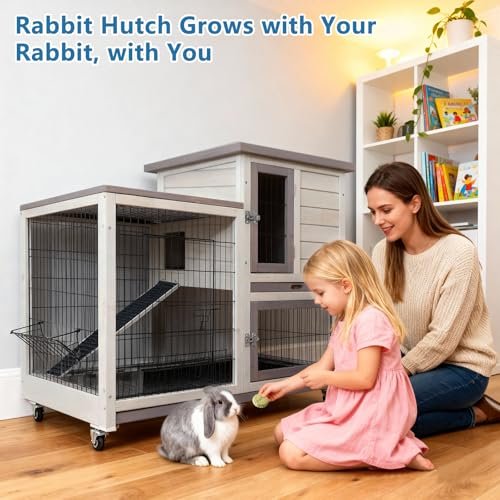
The two-story model (PD-1011B) suits households with a bonded pair of rabbits or a rabbit and guinea pig kept in separate levels. The 5 access doors and chew-resistant ramp between levels give each animal a path to different zones without requiring you to reach awkwardly through a single opening for feeding and spot-cleaning. That said, a bonded pair in a two-story hutch still needs daily exercise time outside the structure — no hutch in this line is large enough to serve as a rabbit's sole living space under r/Rabbits community standards for minimum space. These are designed as sleeping shelters and supervised outdoor enclosures, and FunXplore is straightforward about that.
The larger single-story models — PD-1012 (48.05×26.2×34.3 inches) and PD-1013 (48.1×24.3×36.3 inches) — suit outdoor patio placements where the hutch stays in a fixed position and the animal is let out into a run or yard for exercise. PD-1012's weather-resistant roof and carry handles alongside its wheels make it particularly practical for owners in regions with variable weather who need to shift the hutch between a covered and uncovered area by season. The 45-lb weight puts single-person repositioning at the upper edge of manageable — two people is the better call for moving it any significant distance.
Keeping Hutches Clean, Safe, and Winter-Ready
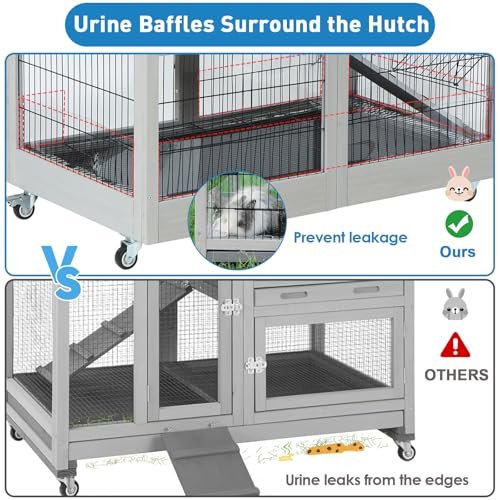
Waste management is where wooden hutch ownership succeeds or fails. The pull-out trays and leakage-proof urine guards present across this line are the detail that determines whether the wood frame stays intact through year two. Urine that contacts raw wood directly wicks into the grain, accelerates rot, and creates an odor that no amount of cleaning fully removes. The urine guards — raised edges around the trays — block splashback from reaching the frame. Slide the trays out, empty and rinse them, slide them back. For owners who want to simplify tray cleaning further, FunXplore's hutch tray liner bags (ASIN B0FT81NZHL) are sized specifically for the PD-1011 footprint (40.6×26.01×37.6 inches) and are available as a separate accessory — disposable plastic liners that drop into the tray and eliminate scrubbing between changes.
Wooden outdoor structures in this category require proactive weatherproofing to stay structurally sound past the first two seasons. The openable and UV-resistant roofs on models like PD-1013 and PD-1012 handle rain without additional treatment, but the wood side panels and floor benefit from an annual coat of exterior wood sealant — especially on any surface that contacts the ground or stays in standing moisture after rain. Before the first winter, pay particular attention to the roof panel seams and the bottom edge of the frame. A small gap at a roof joint becomes a drip point that saturates the wall panel behind it over months.
- Weekly: Pull and empty both trays; rinse with water and allow to dry before reinserting. Check latch hardware — loose latches are the most common predator entry point.
- Monthly: Wipe down interior wire floors with a pet-safe disinfectant. Inspect ramp edges for chewing damage, especially on the aluminum-framed entry points.
- Seasonally: Apply exterior wood sealant to exposed panel surfaces before winter. Tighten all corner bar screws — wood expands and contracts with temperature swings and hardware loosens over time.
- Before moving indoors for storage: Remove all bedding, clean trays, and allow the structure to dry fully. Storing damp wood in a closed garage accelerates mold and warping faster than outdoor exposure does.
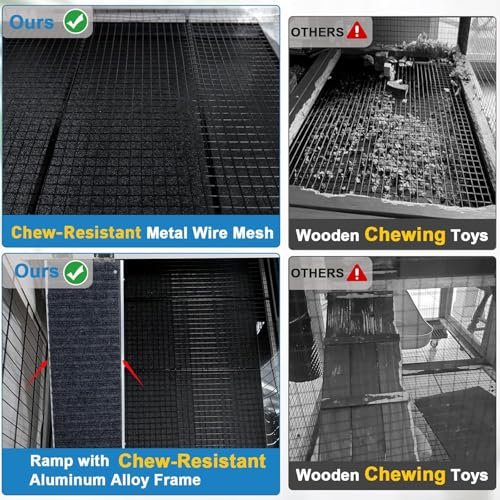
Chew resistance on the ramp edges and entrance frames — where aluminum alloy reinforcement is present — significantly reduces the most common damage point, but no wood structure is chew-proof for a determined rabbit. If your rabbit is a persistent chewer, supervise time inside the hutch until you can confirm which surfaces it targets, and apply a pet-safe bitter apple spray to any raw wood edges showing tooth marks. The wire floor and aluminum-framed entry points will outlast unprotected wood in this respect, but the side panels are still wood and accessible from the inside.
Frequently Asked Questions
Are these hutches large enough to house a rabbit full-time?
Honestly, no — and it's worth saying that directly. The r/Rabbits community's position is that most commercial hutches don't meet the space requirements for a rabbit living in one 24/7, and FunXplore's line isn't an exception. These structures are designed as sleeping shelters, overnight enclosures, and supervised outdoor spaces — not as a rabbit's sole living environment. A rabbit kept in any hutch full-time still needs a minimum of several hours of free-roam exercise daily outside the hutch. If you're setting up a permanent indoor living space, a larger exercise pen or room-roaming setup is the better primary housing solution, with the hutch serving as a sleeping or outdoor component.
What's the wire floor spacing on the hutch models, and is it safe for rabbit feet?
The 0.43-inch wire floor spacing used across the hutch models in this line is designed to let waste fall through for cleaning while keeping rabbit and guinea pig feet from slipping through or getting caught. This measurement is specifically chosen to reduce the risk of sore hocks — the painful pressure wounds that develop when rabbits stand on wire flooring with gaps too wide for their foot size. For smaller breeds and young rabbits, monitor foot health regularly regardless of wire spacing, and consider adding a solid resting board inside the hutch so the animal has a surface to stand on that isn't wire for part of the day.
Can the hutch tray liner bags (B0FT81NZHL) be used with models other than PD-1011?
The liner bags are sized to the PD-1011 footprint — 40.6×26.01×37.6 inches — so they're a direct fit for that model's bottom tray. Before using them with another model, compare that hutch's tray dimensions to those measurements. The PD-1011B (42.6×26.01×38 inches) has a slightly longer base, which may affect fit at the edges. For models with significantly different tray dimensions — like PD-1012 (48.05×26.2 inches) or PD-1003 (40.8×22.8 inches) — the liners are unlikely to lay flat without folding, which can compromise the leakproof function.
How weather-resistant are these hutches for year-round outdoor placement?
Models with openable waterproof or UV-resistant roofs — specifically PD-1013 and PD-1012 — are the best candidates for permanent outdoor placement in exposed positions. The UV-resistant roof panel resists fading and cracking under prolonged sun, and the waterproof designation means rain sheds without pooling. That said, like any wooden outdoor structure, the side panels and floor benefit from an annual coat of exterior wood sealant — the roof handles rain without treatment, but the wood body does not. In climates with harsh winters, moving the hutch to a covered area (garage, carport, covered patio) adds meaningful life to the frame and reduces the maintenance burden in spring. The PD-1012's carry handles alongside its wheels make seasonal repositioning practical for one person on flat ground.
Is the 5-level cage (PD-1028) suitable for a single rabbit, or is it specifically for ferrets and climbing animals?
The PD-1028 is configured for vertically active animals — ferrets, chinchillas, rats, hedgehogs — that naturally climb and use all levels of a tall enclosure. Rabbits don't climb vertical cage levels the same way; they need horizontal floor space to sprint, binky, and move naturally. A 30.1-inch base footprint spread across 5 vertical levels gives very little usable floor space per level for a rabbit, and the vertical configuration doesn't suit rabbit behavior or physical structure. For rabbits, the single-story or two-story hutch models (PD-1011, PD-1003, PD-1013, PD-1012, or PD-1011B) are the right configurations. The PD-1028 is genuinely well-suited for ferrets and other climbing species — it's not a general-purpose cage.
How long does assembly actually take, and can one person do it?
For the single-story hutch models, most owners complete assembly in 1–2 hours with basic tools — a screwdriver is typically all that's required. The two-story PD-1011B takes longer given the additional level and ramp hardware; plan for 2–3 hours, and two people is a real advantage for holding panels steady during frame assembly. The 5-level ferret cage (PD-1028) is the most involved build in the line due to the number of shelf levels and the divider system — budget 2–3 hours and read through all instructions before starting rather than building panel by panel. One consistent note from assembly: take the time to align the roof panel flush and fully tighten all corner hardware before moving the structure outdoors. Gaps at panel joints and loose corner screws are the two points where water infiltration starts, and fixing them before first use is far easier than addressing water damage six months later.